
Fast as a flash
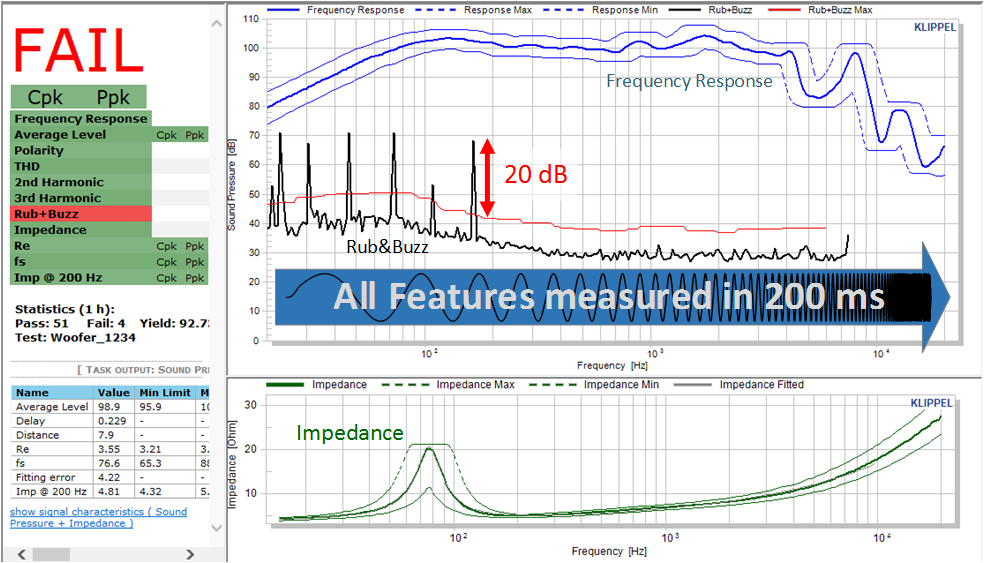
- Ultra-fast testing (> 200 ms)
- Chirp with level and sweep speed profile
- Reliable detection of failures
- More sensitive than a trained human tester
- Robust in a production environment
- Copes with ambient noise
The KLIPPEL Analyzer System provides unique QC measurements optimized for End of Line (EoL) testing that provide maximum sensitivity for defects while requiring minimum measurement time. These fast measurements use special stimuli such as a continuous sine chirp with a flexible sweep speed, which is reduced at frequencies where the loudspeaker needs a longer excitation. Voice coil rubbing, loose particles, air leakage and other irregularities, which generate impulsive distortion that is hardly audible in a noisy production environment, can now be reliably detected. Defects such as these become worse over time and will finally be detected by the end user if not sorted out at EoL.
Application
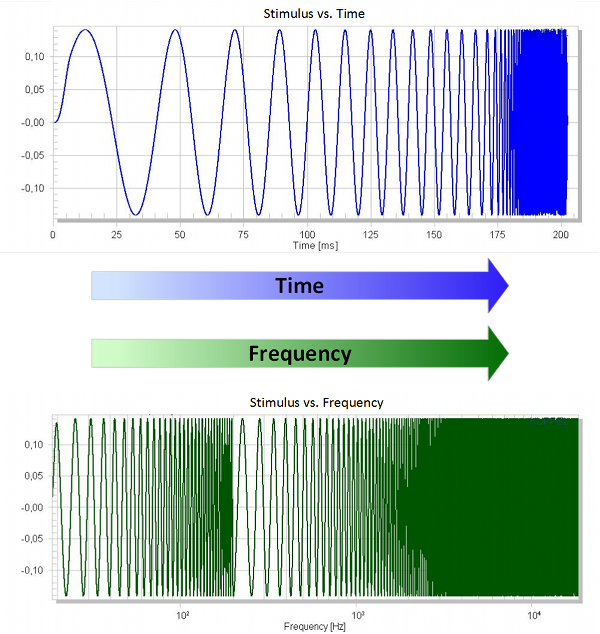
The figure below illustrates a sinusoidal sweep stimulus (chirp) with a speed profile which is optimal for loudspeaker measurements. 90 % of the available measurement time (180 ms) is used to measure the loudspeaker below 200 Hz, but only a very short measurement time (20 ms) is required to measure the loudspeaker at higher frequencies. The chirp, using the speed profile, excites the loudspeaker at all frequencies and provides sufficient energy to activate Rub & Buzz defects.
A complete acoustical and electrical test can be accomplished in far less than 1 s. Ultra fast testing saves measurement time which can be used for repeating the test to gain ambient noise immunity.
The Motor + Suspension Check (MSC) measures the voice coil offset and other large signal parameters in less than 1 s compared to 5 min in the R&D System.